
Kava (Piper methysticum)
Can this Pacific Islands plant help reduce anxiety and improve sleep?
Table of Contents
The term “Kava” often refers to the plant (with the scientific name Piper methysticum), the root, the drink made from it, and products made with kava. In simple terms, there are two main ways to think about consuming kava: kava as a tea-like drink, and kava as a supplement/wellness product.
How Do People Use Kava?
Traditionally, kava is prepared as a shared drink. The root is ground, pounded, or pressed and then mixed with liquid to create a beverage that has been enjoyed socially and ceremonially across Pacific Island cultures for over 3,000 years. People gather in circles to drink kava together, often in the evening, to relax, talk, and mark important events or agreements.
In this context, kava is part social ritual and part calming aid. It is used to:
- Promote relaxation and a sense of calm.
- Ease social tension and support open conversation.
- Honor guests and social occasions
- Create a peaceful, reflective atmosphere in community gatherings
Today, kava is enjoyed far beyond the Pacific as an enjoyable beverage and cultural food. In the United States, people drink kava in kava bars, cafés, and at home much like they enjoy tea or coffee, often as part of a relaxing daily ritual or a social routine with company.
Kava is now widely available in many forms, from it’s traditional style tea-like form made from the natural root to other options like ready-to-drink kava beverages, tinctures, and capsules that fit easily into everyday life much like other health & wellness products.
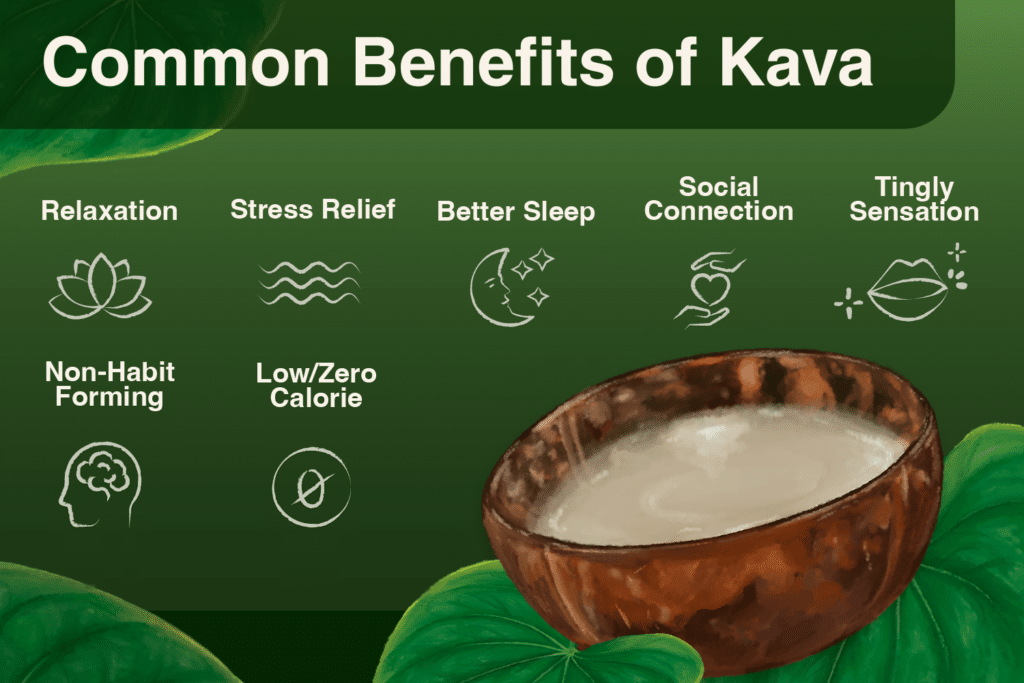
Credit: Kavahana. “Common Benefits of Kava”
Kava Is Also Known As
- Kava kava
- Kawa kawa
- ‘Ava (Samoa)
- ‘Awa (Hawaii)
- Malak (Vanuatu)
- Rauschpfeffer (Germany)
- Sakao (Pohnpei)
- Yaqano (Fiji)
Kava Health Benefits
Kava is unusual in the modern world because it lives in two spaces at once. It is an everyday cultural food enjoyed by millions daily across the world, much like tea or coffee, and at the same time it is one of those rare foods with research suggesting strong benefits for health and mental well-being.
In this sense, many people think of kava as a kind of “super food” enjoyed for it’s tangible short-term as well as long-term health benefits.
Studies suggest that kava can help reduce feelings of stress and occasional anxiety and support a calmer state of mind. Some research has also found improvements in sleep quality, particularly for people whose sleep is disrupted by worry or tension. In clinical trials, kava has often compared favorably to placebo with good tolerability, and many people choose it as a gentler option alongside healthy routines like exercise, good sleep habits, and mindfulness.
The main active compounds in kava root are called kavalactones. These natural molecules work together on important calming pathways in the brain, including GABA and other neurotransmitter systems involved in mood, muscle tension, and the stress response. Scientists continue to study exactly how each kavalactone contributes, yet the overall pattern is clear: kava can promote relaxation and support mental well-being while allowing most people to remain clear-headed and socially present.
Anxiety
Kava is one of the best-studied plants for anxiety. Recent randomized controlled trials and modern meta-analyses, including work published in the 2010s and 2020s, suggest that standardized kava preparations can meaningfully reduce symptoms of mild to moderate anxiety and everyday stress. In these studies, people taking kava often report feeling less tense, less on edge, and better able to cope with daily pressures compared with those taking a placebo.
- Multiple clinical reviews and trials have found kava to be a helpful option for managing anxiety. A review of seven clinical trials involving 645 participants concluded that kava was an effective symptomatic treatment for anxiety, demonstrating measurable benefits across studies.
- These findings were reinforced by a 2011 Australian review, which found kava to be more effective than a placebo in treating generalized anxiety disorder. The review highlighted traditional kava preparations as a well established and culturally rooted approach.
- Further support came from a 2013 randomized controlled trial, where kava significantly reduced anxiety symptoms in individuals with generalized anxiety disorder. By the end of the study, 26% of participants in the kava group experienced full remission of their anxiety symptoms.
- More recently, a 2023 review echoed these outcomes, concluding that current research on kava as an anxiety treatment is promising and consistently demonstrates positive effects across clinical studies.
It is important to note that most of these clinical studies were done with standardized “kava extracts” in capsules or liquid form rather than with a cup, or “shell,” of the traditional-style kava beverage. You can think of these extracts in a similar way to how tea, which can be enjoyed as a simple brewed cup, can also be processed and isolated into more concentrated preparations for medical use cases. In much of the older scientific and medical writing, the words “kava,” “kava extract,” and “kava beverage” were often used interchangeably. That blurred language later contributed to confusion when early safety concerns about specific products were discussed as if they applied equally to all forms of kava. We will come back to this distinction in the safety section.
Insomnia and Sleep
For many Pacific Island communities, kava is traditionally shared in the evening to unwind, quiet the mind, and prepare for rest. People who drink kava today often say it helps them fall asleep more easily and sleep more deeply, especially when their sleep problems are tied to stress or worry.
Research on kava and insomnia is smaller than the anxiety data but not zero.
“A randomized, placebo-controlled trial in people with anxiety-related sleep problems found that a standardized kava extract improved reported sleep quality and how refreshed people felt on waking compared with placebo.”
Small sleep-lab and animal studies suggest that certain kavalactones can increase deep non-REM sleep without suppressing REM, which supports a possible sleep-supporting effect. Taken together, this suggests that kava may help with sleep when insomnia is closely linked to stress and anxiety, while the overall research base is still limited enough that it should not be viewed as a fully proven stand-alone treatment for chronic insomnia.
Inflammation
Kava also shows promising anti inflammatory activity. Several lab and animal studies have found that individual kava compounds can dial down key inflammatory pathways in cells. For example, flavokavain A reduced IL 1β induced expression of inflammatory mediators like iNOS and COX 2 in mouse cartilage cells and lowered cartilage damage in an osteoarthritis mouse model.
The American Herbal Pharmacopoeia’s 2025 monograph on kava summarizes these findings by classifying kava, based on in vitro and in vivo work, as having anti inflammatory, antioxidant, and neuroprotective properties, while noting that formal human trials specifically targeting inflammatory diseases are still limited.
Cancer
Kava has drawn growing scientific interest for its possible role in reducing long-term cancer risk. Epidemiologic data from Pacific Island nations suggest an inverse relationship between traditional kava use and overall cancer incidence, with men in high-kava consuming countries showing lower cancer rates than women, which is the opposite of the usual global pattern and consistent with men drinking more kava than women.
Building on that, multiple studies show that kava and specific kavalactones can reduce tumor formation in models of lung, colon, prostate, and bladder cancer.
In tobacco-carcinogen lung models, kava has reduced the number of lung tumors when given during or after carcinogen exposure, at doses comparable to traditional human use. Mechanistically, kava appears to: support detoxification and excretion of tobacco carcinogens, reduce DNA damage in lung tissue, calm pro-inflammatory signaling, and modulate stress-related pathways that may contribute to lung cancer risk.
A recent 2023 review on “Opportunities and Challenges of Kava in Lung Cancer Prevention” concludes that kava has “promising potential” as a lung cancer chemopreventive agent, based on this combination of Pacific Island population data, multiple animal models, and early human biomarker work in smokers.
In everyday language, the fairest summary is that kava is a traditional calming food whose natural compounds look very promising in the lab and in animal models for lowering cancer risk, especially related to tobacco, but it should not be used as a substitute for medical cancer care.
Side Effects of Kava
Kava is considered extremely safe when used in normal amounts and has been enjoyed as a shared drink for over 3,000 years in Pacific Island communities, often by whole families across generations. You may still see websites warning about severe side effects or liver damage, but most of those publications are repeating outdated or misunderstood information and do not reflect modern reviews of the kava that millions across the world consume today.
For most people, the only noticeable side effects are mild and expected, such as:
A brief tingly or numbing sensation in the mouth, similar to Sichuan peppercorn – this is normal and many people come to enjoy this sensation.
A comfortable sense of relaxation or calm
Occasionally, mild dry skin or lips in people who drink a lot of kava, which usually clears quickly with good hydration and dialing back intake
Serious problems with modern, food-grade kava are extremely rare. As with any tea or herbal drink, it is still sensible to stay hydrated, avoid overdoing it, and check with a health professional if you have medical conditions or take multiple medications.
The Liver Damage Misconception
Kava has been enjoyed as a family drink in Pacific Island cultures for thousands of years. It is common for people to consume kava regularly over decades, often as part of family and community life, without any recognized pattern of liver disease linked to this use.
Historical and anthropological reviews that look specifically at kava-drinking communities reach the same conclusion: there is no clear signal of excess liver disease that can be attributed to kava.
In the modern era, kava was first brought into European medicine because of its positive effects. Standardized kava preparations of “kava extracts” were developed and prescribed for anxiety, and official bodies such as Germany’s Commission E recognized kava extracts as effective for nervous tension based on clinical trials that found meaningful benefit and good tolerability. At that stage, kava was viewed primarily as a useful, relatively gentle option for anxiety support.
The “kava liver damage” controversy comes from a later and much narrower context. In the late 1990s and early 2000s, a specific pharmaceutical kava product was used in Germany and a few other countries in patients who were often already unwell and taking multiple other medications. A small number of these patients developed liver problems. Instead of being treated as a signal about that particular medicinal product and patient group, these cases were reported under the broad heading of “kava hepatotoxicity,” and concern was generalized to kava in all forms.
When these case reports were re-examined in detail, independent reviewers found several consistent features. Many patients were on other drugs known to affect the liver or had significant alcohol use or pre-existing liver issues. Documentation was frequently incomplete, with some cases duplicated across reporting systems. When the total number of reports was compared with the very large number of doses of medicinal kava that had been used, the estimated frequency of suspected liver injury was extremely low. Later analyses and World Health Organization reviews described true kava-related liver reactions as extremely rare and likely idiosyncratic, rather than a predictable effect of kava itself, and emphasized that this pattern was not seen in traditional kava-drinking populations.
Modern regulatory and scientific positions now reflect this broader evidence base. World Health Organization and Food and Agriculture Organization evaluations conclude that, taken together, traditional use, clinical trial data, and pharmacovigilance records support the view that kava beverage can be consumed with an acceptably low level of health risk.
In 2025, after reviewing historical use and modern safety evidence, the United States Food and Drug Administration (FDA) officially confirmed that kava, prepared and consumed as kava tea, is treated as a conventional food under federal law, provided ordinary food safety and labeling standards are met. This clarification has already informed decisions by states such as Hawaiʻi and Michigan to recognize kava beverage as “Generally Recognized as Safe” (GRAS) as a food, based on its extensive history of safe cultural use and current scientific data.
Research has also begun to explore potential liver-supporting effects of individual kava compounds. The kavalactone yangonin, for example, has shown protective effects in experimental models of non-alcoholic fatty liver disease and alcohol-related liver injury, improving liver markers through well-described receptor pathways. These findings are preliminary and do not make kava a liver treatment, but they are consistent with the observation that kava is in no way a liver toxin.
Overall, the current scientific and regulatory consensus is clear. Kava made from good quality root and used as a beverage or food has an excellent liver safety profile in healthy adults. Many of the severe warnings about kava that still appear online are based on early, incomplete interpretations of a narrow pharmaceutical episode and do not reflect the full body of evidence now available.
Precautions and Contraindications
When prepared and consumed as kava tea, kava is classified by the U.S. FDA as a conventional food, in the same regulatory category as drinks like tea or coffee. In this form, it is treated as an ordinary cultural beverage and, for most healthy adults, does not require special precautions beyond the kind of common-sense moderation you would use with any relaxing drink.
Kava tea is not intoxicating. People generally remain clear-headed, coordinated, and in control of their behavior, even while feeling calmer and more at ease.
Kava extracts and supplement forms
More care is appropriate with concentrated extracts and kava in supplement products (capsules, tinctures, and other extract forms), because the dose can be higher and more variable. With these forms, it is sensible to:
Avoid use in pregnancy and breastfeeding unless a qualified healthcare professional is directly involved.
Talk with a clinician if you take strong sedative or psychoactive medications, such as sleeping pills, benzodiazepines, certain antihistamines, or other drugs that cause drowsiness. Kava can add to their calming effects.
Be cautious with activities requiring quick reactions. Kava is not intoxicating, but if a particular product makes you feel heavy or very sleepy, wait until you feel fully alert again before driving or operating machinery.
Seek medical guidance if you have serious neurological or psychiatric conditions. Most clinical research has been in otherwise healthy adults with mild to moderate anxiety, not in complex cases.
Drug Interactions
The FDA now treats kava prepared and consumed as kava tea as a regular food, in the same regulatory category as drinks like tea or coffee when it follows standard food safety and labeling rules. In this everyday beverage context:
Kava is not intoxicating and there are no well-documented serious drug interactions in healthy adults.
The main practical consideration is that kava has a calming effect. If you already take medicines that make you drowsy (for example some sleep medicines or strong antihistamines), drinking a lot of kava at the same time may make you feel more relaxed or sleepy than usual.
If you personally feel very relaxed or heavy after kava, give yourself time to feel fully alert again before driving or doing anything that demands fast reactions.
For most people, kava tea behaves like a gentle relaxing food rather than a high-risk drug from a interactions perspective.
Dosage and Preparation
Because kava tea is considered a food (not a drug), there is no single “correct” dose. Pacific Island communities have safely used a wide range of amounts for generations, often sharing many cups (called “shells”) in a session with no adverse reactions. Most people simply start with a small serving, notice how they feel, and adjust slowly from there.
There are three main forms of natural kava tea you’ll see on the market today:
Traditional kava
Coarsely ground or pounded kava root which you mix with liquid, and knead and strain through a cloth or fine strainer.Instant kava / “kava nectar”
This is the essentially dehydrated kava beverage. It has already been prepared and then dried, so it can usually be stirred straight into liquid without kneading or straining.
In traditional settings, it is normal for islanders to drink multiple cups per session and to do so regularly over years without problems. For newcomers, a simple approach is to start with a modest serving of whichever kava tea you are using, wait to see how relaxed you feel, and only increase gradually if you want a deeper effect, always staying within what feels comfortable and clear-headed for you.
What to Look For
A common misconception is that kava is “unregulated.” In reality, kava tea is regulated as a conventional food, and kava products in capsule or tincture form are regulated under the same dietary supplement framework that applies to other herbs and nutrients. That means kava foods and supplements must follow standard rules for safety, manufacturing, and labeling, just like other products on the shelf.
When you choose kava, it helps to pay attention to a few key details:
Natural kava tea (traditional kava, micronized, instant kava, kava nectar)
The label should clearly say it is made from noble kava root.
Traditional and micronized kava are ground root meant to be kneaded and strained. Instant or “kava nectar” is a dehydrated kava beverage that does not require straining and can be mixed like green tea powders.
These are closest to the way kava has been enjoyed for centuries as a cultural food.
Kava extracts and supplements (capsules, tinctures, shots)
The label should clearly say “kava extract” along with the type of extract and approximate amount per serving.
Look for brands that explain their sourcing, testing, and quality controls, just as you would with any other supplement.
Other Questions About Kava
With kava becoming more popular outside the South Pacific, you may find yourself curious about a few key aspects of it:
Is kava intoxicating?
No. The scientific name Piper methysticum means “intoxicating pepper,” however, this is a mislabeling from 250 years ago. Kava does not intoxicate. It supports calm, relaxation, and connection without impairing judgement.
Is kava addictive?
Kava is not considered addictive. Unlike coffee, it contains no caffeine, and stopping kava does not produce a withdrawal syndrome. People tend to return to kava for its calming effect and shared ritual, not because of chemical craving.
Is kava regulated, or is it a “grey-area” substance?
The kava beverage, or “kava tea” is regulated in the United States as a conventional food, in the same legal category as beverages like tea or coffee.
Kava capsules and tinctures are regulated as dietary supplements, under the same rules that apply to other herbs and nutrients. Products still have to follow normal food or supplement safety and labeling standards.
Can kava be part of a regular routine?
Yes. In Pacific Island cultures, kava has been part of daily life for generations. For healthy adults, natural kava tea can be enjoyed regularly as a cultural food, similar to how others enjoy tea or coffee, as long as you listen to your body, stay hydrated, and avoid combining heavy kava use with strong sedative medications.
22 Sources
- Sarris, J., Stough, C., Bousman, C. A., et al. (2013).
Kava in the treatment of generalized anxiety disorder: A double-blind, randomized, placebo-controlled study.
Journal of Clinical Psychopharmacology, 33(5), 643–648.
https://pubmed.ncbi.nlm.nih.gov/23348842/ - Pittler, M. H., & Ernst, E. (2002).
Kava extract for treating anxiety.
Cochrane Database of Systematic Reviews, (2).
https://pubmed.ncbi.nlm.nih.gov/12404572/ - Kavahana. (n.d.).
What are kavalactones and why they are an important piece of your kava experience.
https://kavahana.com/articles/about-kava/what-are-kavalactones-and-why-they-are-an-important-piece-of-your-kava-experience - Burton, N., Sneed, K. B., & Pathak, Y. (2023).
Systemic review of the use of kava kava for the reduction of anxiety disorder.
Medicon Medical Sciences, 5(2), 37–46.
https://themedicon.com/pdf/medicalsciences/MCMS-05-149.pdf - Sarris, J., LaPorte, E., & Schweitzer, I. (2011).
Kava: A comprehensive review of efficacy, safety, and psychopharmacology.
Australian & New Zealand Journal of Psychiatry, 45(1), 27–35.
https://pubmed.ncbi.nlm.nih.gov/21073405/ - Sarris, J., et al. (2013).
Kava in the treatment of generalized anxiety disorder: A randomized clinical trial.
Journal of Clinical Psychopharmacology, 33(5), 643–648.
https://pubmed.ncbi.nlm.nih.gov/23635869/ - Burton, N., Sneed, K. B., & Pathak, Y. (2023).
Systemic review of the use of kava kava for the reduction of anxiety disorder.
Medicon Medical Sciences, 5(2), 37–46.
https://themedicon.com/pdf/medicalsciences/MCMS-05-149.pdf - Lehrl, S. (2004).
Clinical efficacy of kava extract WS 1490 in sleep disturbances associated with anxiety disorders.
Journal of Affective Disorders, 78(2), 101–110.
https://pubmed.ncbi.nlm.nih.gov/14706720/ - American Herbal Pharmacopoeia. (2025).
Kava rhizome with root monograph.
https://herbal-ahp.org/ahp-monographs-kava-rhizome-root/ - Zhang, X., et al. (2019).
Opportunities and challenges of kava in lung cancer prevention.
Cancer Prevention Research, 12(11), 711–720.
https://pubmed.ncbi.nlm.nih.gov/31506483/ - American Herbal Pharmacopoeia. (2025).
Kava rhizome with root monograph.
https://herbal-ahp.org/ahp-monographs-kava-rhizome-root/ - International Kava Organization. (n.d.).
World Health Organization review of kava safety.
https://internationalkava.org/world-health-organization-kava-study-review/ - American Herbal Pharmacopoeia. (2025).
Kava rhizome with root monograph.
https://herbal-ahp.org/ahp-monographs-kava-rhizome-root/ - Showman, A. F., et al. (2022).
Traditional kava use and human health: A comprehensive review.
Nutrients, 14(22), 4704.
https://pmc.ncbi.nlm.nih.gov/articles/PMC9634090/ - Teschke, R., et al. (2023).
Kava hepatotoxicity: A critical analysis of case reports and regulatory decisions.
Nutrients, 15(9), 2037.
https://pmc.ncbi.nlm.nih.gov/articles/PMC10253622/ - International Kava Organization. (n.d.).
World Health Organization review of kava safety.
https://internationalkava.org/world-health-organization-kava-study-review/ - National Center for Biotechnology Information (NCBI). (2023).
Kava. In StatPearls.
https://www.ncbi.nlm.nih.gov/books/NBK350450/ - Kavahana. (n.d.).
Does kava cause liver damage? Debunking the myth with scientific evidence.
https://kavahana.com/articles/kava-science/does-kava-cause-liver-damage-debunking-the-myth-with-scientific-evidence - World Health Organization & Food and Agriculture Organization of the United Nations. (2016).
Kava: A review of the safety of traditional and recreational beverage consumption.
https://openknowledge.fao.org/server/api/core/bitstreams/f97fbe5f-244e-4301-be2a-03ac39ef630b/content - National Law Review. (2025).
FDA officially confirms kava as a food under federal law.
https://natlawreview.com/press-releases/fda-officially-confirms-kava-food-under-federal-law - Zhang, X., et al. (2019).
Kava consumption and cancer risk: Mechanistic and epidemiologic insights.
Cancer Prevention Research, 12(2), 99–108.
https://pubmed.ncbi.nlm.nih.gov/30668392/ - International Kava Organization. (n.d.).
Kava consumer fact sheet.
https://internationalkava.org/kava-consumer-fact-sheet/